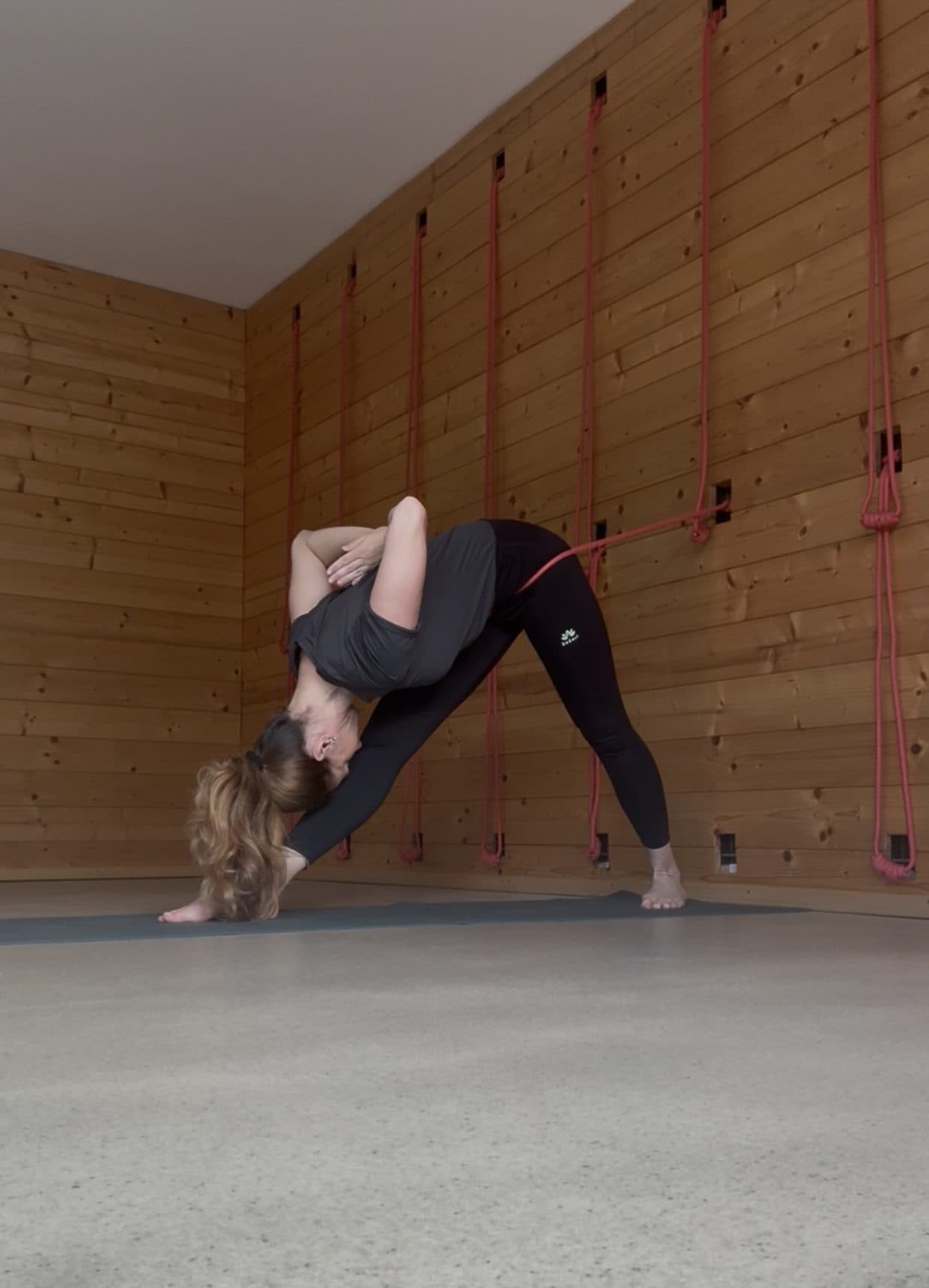
5 Reasons to Start Iyengar Yoga
Precise alignment for safe practice
In Iyengar yoga, every pose is executed with exceptional attention to body alignment. This means every bone, muscle, and joint has a specific purpose and position. You're not just "doing the pose" — you're building it from the ground up, with intention.
Props make poses accessible
Blocks, belts, blankets, wall ropes, and chairs — these are the tools that make Iyengar yoga unique. They're not training wheels. They're intelligence. They allow you to experience correct alignment even if your body isn't there yet.
Therapeutic effect for pain and chronic conditions
I started practicing yoga because of persistent back pain. After my second Iyengar yoga class, I felt the difference. After three months, the pain was gone. And after 10 years, it has never returned.
Deep body awareness
Unlike flowing styles where you move quickly from pose to pose, in Iyengar yoga we hold poses longer. This builds strength, stability, and the ability to observe what's actually happening in your body.
Meditation in action
B.K.S. Iyengar once said: "Yoga teaches us to cure what need not be endured and endure what cannot be cured." This is the heart of why Iyengar yoga works.
Suitable for every age
When I started teaching, I was surprised by the diversity in my classes. I have students aged 18 to 80, and I can honestly say that Iyengar yoga welcomes all of them. A teenager working on flexibility benefits from the same foundational principles as a 70-year-old building strength and balance. The beauty of Iyengar yoga is its adaptability. Using props and modifications, I can make each pose accessible to anyone, regardless of age. I had one student start at 75 with significant stiffness and arthritis. After six months of consistent practice, she noticed improved mobility and confidence in her daily movements. Age is truly just a number in yoga—what matters is consistency and listening to your body.
A science-backed practice
Iyengar yoga isn't just philosophy—it's backed by serious research. Studies show that Iyengar yoga significantly reduces chronic pain, including back and neck pain, which is why I initially started practicing. Research published in peer-reviewed journals demonstrates improvements in flexibility, strength, balance, and even mental health markers like anxiety and depression. What I appreciate most is the precision focus. When we align the body correctly, we're not just stretching muscles; we're improving circulation, decompressing joints, and activating stabilizer muscles that modern life often neglects. The British Iyengar Yoga Association maintains strict teaching standards ensuring that every certified instructor, including myself, can guide students safely through evidence-based practices. I always tell my students: feel the science in every pose.
What makes an Iyengar yoga class different
If you've tried other yoga styles, you'll notice Iyengar classes feel different from the start. We move slowly and deliberately. Every pose receives detailed verbal instruction about alignment—where your feet should be, how to engage your thighs, which part of your spine to lengthen. I might spend ten minutes on a single pose, adjusting students' alignment through touch or using props like blocks and straps. This precision prevents injury and deepens the pose's benefits. We don't chase how many poses we complete; we explore how deeply we can understand each one. Music is rare; silence or gentle sounds dominate. There's also a logical sequence—we start with warm-ups, progress through standing poses and backbends, finish with forward bends and restorative poses. This structure creates a complete practice that affects both body and mind.
The role of a certified teacher
Not all yoga teachers are created equal. My certification through the British Iyengar Yoga Association and the Ramamani Iyengar Institute in Pune represents thousands of hours of rigorous training. A certified Iyengar teacher understands anatomy deeply—nerve pathways, bone structure, muscle function. We learn how to recognize and modify poses for different bodies and conditions. This certification means I can safely guide someone with a herniated disc, offer modifications for pregnancy, and understand when a student needs medical clearance before practicing. Many yoga teachers are wonderful people, but certification ensures accountability and standardized knowledge. When you practice with a certified Iyengar teacher, you're investing in safety and effectiveness. I continue studying and refining my craft because yoga teaching is a lifelong journey of learning.
How to start in Sofia
Starting yoga in Sofia has never been easier. Studio Namaste is located conveniently in the city center and offers beginner classes specifically designed for people new to Iyengar yoga. I recommend visiting the studio first to meet teachers, see the props available, and feel the teaching style. Most studios in Sofia, including Studio Namaste, offer trial classes at reduced rates. Start with a beginner or foundational class, not an intermediate one, even if you're fit or flexible. Your first class might feel challenging simply because your body is learning a new language of movement. Come with no expectations except to observe how your body responds. I always tell newcomers: avoid comparing yourself to other students. Your yoga practice is uniquely yours, and the real transformation begins when you stop looking around the room and start looking inward.
Frequently Asked Questions
Do I need to be flexible for Iyengar yoga?
No, flexibility is not a prerequisite—it's often the result. Many of my students came to yoga tight and stiff. Iyengar yoga uses props and modifications to meet you exactly where you are. Starting with limited flexibility actually helps you understand the poses more deeply because you learn proper alignment without forcing yourself into shapes.
How often should I practice?
Ideally, 2-3 times per week allows your body to learn and progress while giving recovery time. However, even one class weekly brings benefits. Consistency matters more than intensity—one class every week is better than sporadic intense practice. Many students find adding home practice between classes accelerates their progress.
Is there an age limit?
No. I teach students from 18 to 80+. Iyengar yoga adapts beautifully to different life stages. Children benefit from the focus and alignment principles, while seniors appreciate the safety and functional improvements for daily life. Your age simply determines which modifications and progressions suit you best.
Can I practice with an injury or pain?
Often yes, but always inform your teacher. Iyengar yoga's therapeutic approach means we can modify poses for existing injuries. For acute injuries, consult your doctor first. For chronic pain like back pain, Iyengar yoga frequently helps, but requires proper guidance to avoid aggravating the condition.
What equipment do I need?
Nothing initially. Studio Namaste provides all props—mats, blocks, straps, bolsters, blankets. At home, you might add a yoga mat and blocks later, but these are optional starting out. The studio's comprehensive prop collection is one reason group classes are perfect for beginners.