How Props Transform Your Practice
Why props are not training wheels
There's a misunderstanding that props in yoga are for beginners or people who "can't." The truth is the opposite — B.K.S. Iyengar himself used props extensively, and so do advanced students. They're tools for deeper understanding.
Blocks and blankets — the foundation of practice
Cork blocks are perhaps the most-used prop. They bring the ground closer to you — in standing poses, in forward bends, in seated poses. A simple shift changes everything about how your spine aligns.
Belts and wall ropes
The belt extends your arms — literally. If you can't reach your feet in Paschimottanasana, the belt bridges that gap. Over time, as flexibility increases, you use the belt less. But when you do, you understand the pose better.
The chair — the unexpected helper
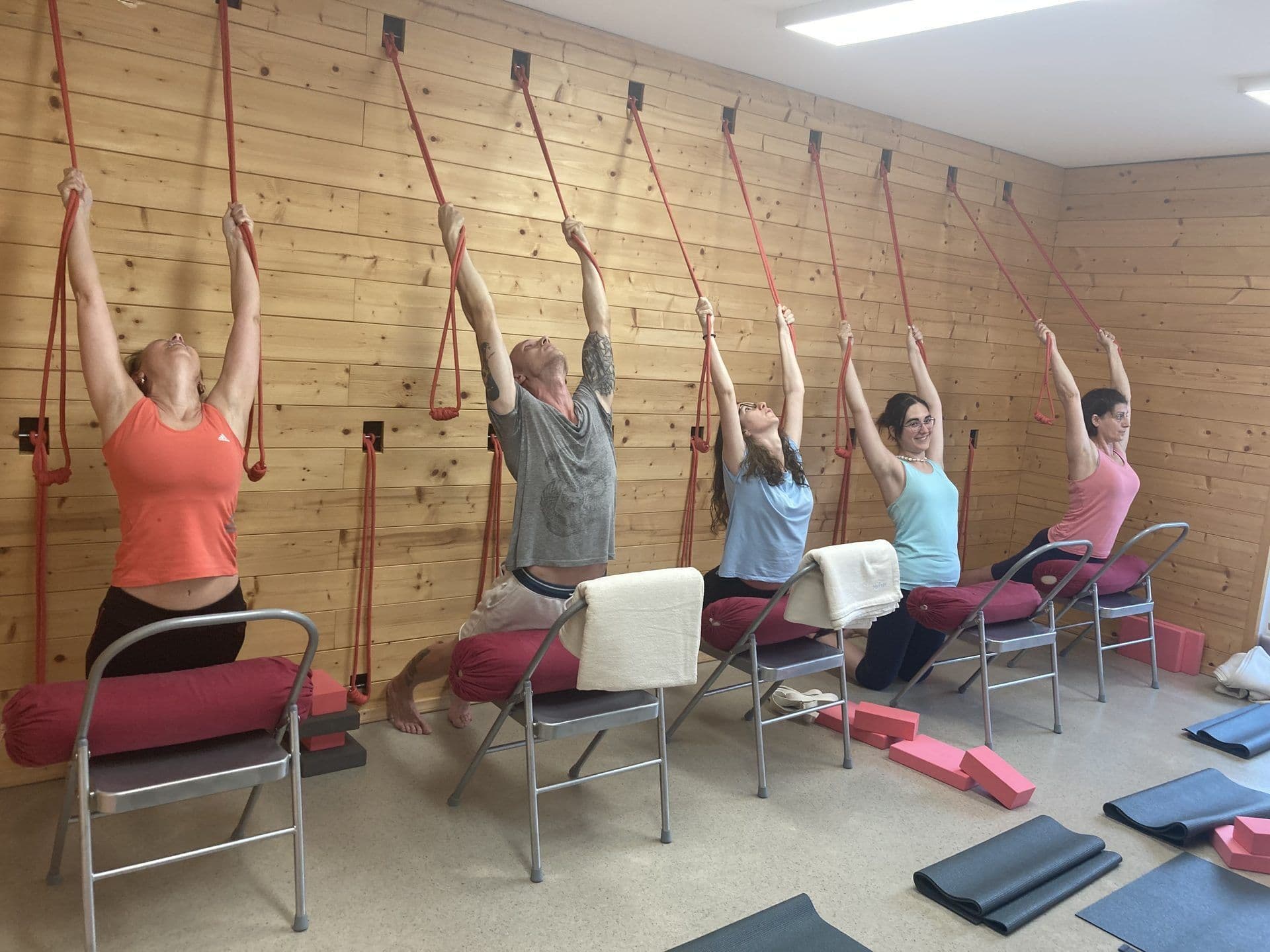
The metal folding chair is perhaps the signature prop of Iyengar yoga. It's used for inversions, support in standing poses, and restorative work. It looks simple. It's profound.
Wall ropes—unique to Iyengar yoga
When visitors first see Studio Namaste's wall with ropes, they often ask, 'What are those?' Wall ropes are a signature Iyengar yoga feature, and they transform practice in ways other styles rarely offer. These sturdy ropes hanging from the wall provide traction and support for deep backbends, inversions, and therapeutic stretches. I use wall ropes to safely decompress the spine, lengthen the hamstrings, and even provide safe supported inversions for students with neck issues. For someone with back pain like I once experienced, wall ropes allow controlled spinal traction that relieves compression. They're particularly valuable for restorative poses—I might use them to support a gentle backbend where the student stays for several minutes, allowing deep release. While other yoga styles use creative props, wall ropes represent Iyengar yoga's commitment to precision tools designed specifically for therapeutic benefit. They're one feature that makes Iyengar classes truly unique.
Props for restorative poses
Restorative yoga is the hidden gem of practice. Using carefully arranged bolsters, blankets, and eye pillows, we create poses that calm the nervous system and release deep tension. I might guide students into a supported backbend over a bolster—the spine gently opens while arms and shoulders relax completely. A blanket under the head supports the neck, an eye pillow softens the eyes and quiets the mind. These poses held for five or more minutes activate the parasympathetic nervous system, telling your body it's safe to rest and digest. For those carrying stress and tension, restorative practice is medicine. After years of demanding work, I introduced restorative sessions at Studio Namaste because I realized students needed permission and structure to slow down. Props make this possible—they do the supporting so your muscles can release. Unlike vigorous styles, restorative yoga doesn't challenge your limits; it meets you exactly where you are and says, 'rest here.'
How props help specific conditions
One of Iyengar yoga's greatest strengths is therapeutic application. For back pain, I use blocks under the pelvis in bridge pose to support the lumbar spine safely. For tight shoulders, straps help extend the arms without forcing. Pregnant students benefit from bolsters and modifications that support their changing bodies. Students with knee issues avoid deep kneeling using props that reduce joint compression. I had a student with arthritis in her hips who thought yoga was finished for her. With props—a block under her sitting bones during poses, a strap to support forward bends—she regained mobility and confidence. Props aren't substitutes for medical care, but they're powerful therapeutic tools. They allow precise, safe exploration of poses that might otherwise be impossible. This customization is why Iyengar yoga appears so often in physiotherapy and pain management settings.
Do I need your own props
No—Studio Namaste provides everything you need for class. Our collection includes blocks, straps, bolsters, blankets, wall ropes, and specialized supports. This abundance means you can focus on practice rather than equipment. However, many dedicated students eventually buy props for home practice. I recommend starting with a yoga mat and blocks—they're inexpensive and versatile. A strap helps deepen stretches. A bolster enables restorative practice. Build gradually based on your interests. Some students never need home props; they practice in the studio where everything's available. Others love the convenience of home practice and invest in a basic setup. My suggestion: don't buy equipment before understanding what you'll actually use. Start at the studio, discover your practice style, then thoughtfully choose what serves your home practice.
Frequently Asked Questions
Can I use props at home?
Absolutely. Blocks, straps, and bolsters work beautifully at home. You can also improvise: yoga blocks substitute with sturdy books, straps with scarves or belts. Walls work for wall rope poses if you're careful. Many students develop a home practice using basic props and find it complements their studio classes perfectly.
Which props should I buy first?
Start with a yoga mat and blocks—they're versatile and affordable. Blocks support almost every pose and prevent force. A yoga strap is next—it extends reach and deepens stretches safely. A bolster comes later if you want restorative practice. Buy quality items; they last decades and make practice more enjoyable.
Are props only for beginners?
No, advanced students use props extensively. Props allow deeper exploration, therapeutic modifications, and subtle alignment refinements. Even experienced practitioners benefit from props—they're not crutches but tools for precision and safety at every level.
Can I install wall ropes at home?
Yes, but carefully. Wall ropes require professional installation into solid wall structure with proper load-bearing support. I recommend consulting a contractor to ensure safety. Many students enjoy ropes during studio classes and do other poses at home using accessible props.
Which props help with back pain?
Blocks under the pelvis in bridge pose, straps to safely extend forward bends without forcing, and bolsters for supported backbends. Wall ropes provide traction that many find relieving. Discuss your specific back pain with your teacher—they'll recommend the most helpful props and modifications for your condition.